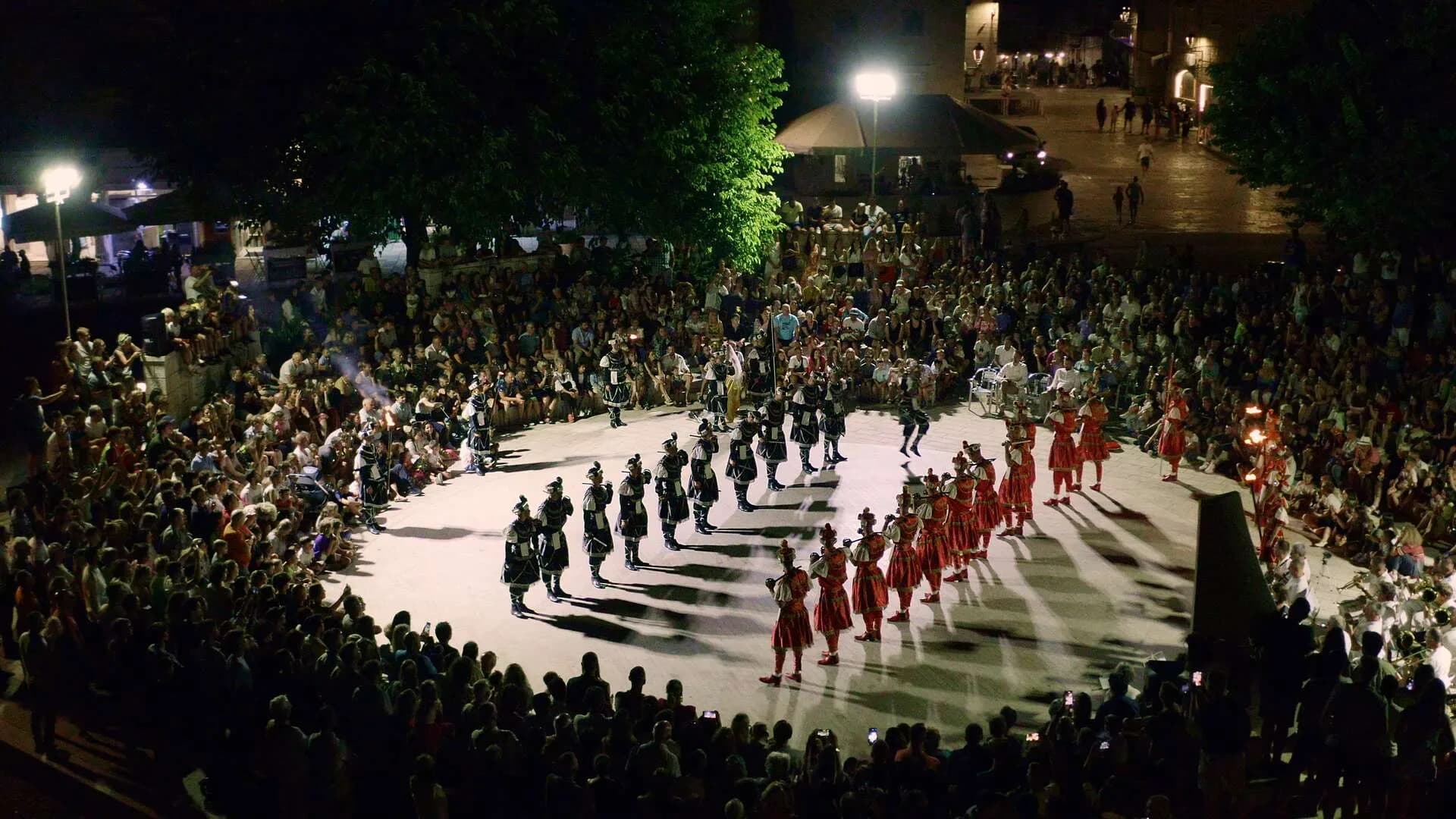
You have booked an evening in Korčula, you have heard there is a centuries-old sword dance, and now you want to know what you are actually walking into. This is the practical guide: what happens on stage, how long it lasts, what to wear, and how to make sure you get a good seat.
The short version: you are about to watch Europe's last surviving authentic war dance, performed with real iron swords by the people of Korčula, exactly where it has been performed for generations. It is loud, it is physical, and it is unlike any folklore show you have seen before.
What the Moreška actually is
The Moreška is not a re-enactment staged for tourists. It is a living tradition that traces back to the medieval "Moros y Cristianos" mock battles of the Mediterranean, the earliest recorded performance was in Lérida, Spain, in 1150, and it has been documented in Korčula since a town journal entry dated 7 March 1666. As the same war dances faded from every other town on the Dalmatian coast, Korčula became the last place where the authentic form survived.
Today it is officially recognised as a protected cultural good of the Republic of Croatia, and it is staged by HGD Sveta Cecilija, the cultural society that has been its guardian since 1883.
The story you'll be watching
The Moreška is a drama as much as a dance. Two kings fight over one woman.
The Bula, a young woman, has been taken by force by Moro, the Black King. The White King, Osman, her betrothed, arrives to win her back. The Bula refuses to yield to her captor: "All I ask of you… far more pain for me is your unwanted love than the steel." What follows is a challenge, and then seven escalating sword battles to decide her fate.
The dialogue is spoken in an archaic 17th-century Korčulan dialect, so you will not understand every word even if you speak Croatian, and that is fine. The story is told in the bodies, the swords and the music. (If you want the plot in your own language, ask at the entrance: a short program guide is usually available, and we recommend it.)
The shape of the evening
A typical performance unfolds in three parts:
- The opening, the evening usually begins with Klapa Sveta Cecilija, a male a cappella ensemble singing traditional Dalmatian song, and the live Wind Orchestra. This is your moment to settle in.
- The drama, the spoken confrontation between the kings and the Bula sets up the conflict.
- The dance, the seven kolapi (sword-clash figures), each faster and fiercer than the last, ending in the surrender of the Black King and the freeing of the Bula.
Plan for an evening of roughly an hour end to end. The combat itself is the climax, so if the opening songs feel slow, stay with it; the payoff is worth it.
The part everyone remembers: the swords
This is what sets the Moreška apart from any other folk dance in Europe. Every dancer wields two iron swords, the right hand strikes, the left parries. Each blade weighs about a kilogram, and they are real.
When the armies clash, the swords strike hard enough to throw sparks, and the sound, bam, bam, bam, rings off the stone walls of the old town. It is genuinely percussive; you feel it as much as hear it. The choreography is fixed and has been passed down unchanged for generations: seven figures named Rugier, Moreška, Finta, Moro in dentro, Križ (the Cross), Rugier de fuorivia, and the furious Final Figure danced at full speed.
This is also why the front row comes with a gentle warning: you are close to real steel. The dancers are highly trained and strike with precision, but the first rows are an immersive, occasionally intense place to sit. If you are bringing small children or you would simply rather take it all in from a calmer vantage point, a few rows back is perfect.
Practical tips for your visit
- Showtime is 21:00. Performances run on selected evenings through the season, check the current performance schedule and book tickets before you go, as dates vary week to week.
- Arrive early for the best seats. This is the single most common piece of advice from past visitors. Seating is not numbered, so the earlier you arrive, the more choice you have. Aim for 20–30 minutes before the start.
- The venue is the Summer Cinema (Ljetno kino), an open-air stage in the old town. It is tucked into the historic streets, so give yourself a few extra minutes to find it the first time.
- Dress comfortably. Summer evenings in Korčula are warm but the open-air setting can cool down after sunset, a light layer is a good idea.
- Tickets: €20 for adults, €10 for children under 14. Groups get every fifth ticket free. (More on bringing children in our guide, Is Moreška Suitable for Kids?)
Why it's worth it
Plenty of destinations offer a "traditional show." Very few offer something that has genuinely never stopped, performed by the same community, in the same place, with the same iron, for centuries. The Moreška is not a performance about Korčula's history; it is a piece of that history, still happening.
Come for the swords. Stay for the realisation that you are watching something almost nowhere else on earth can offer.