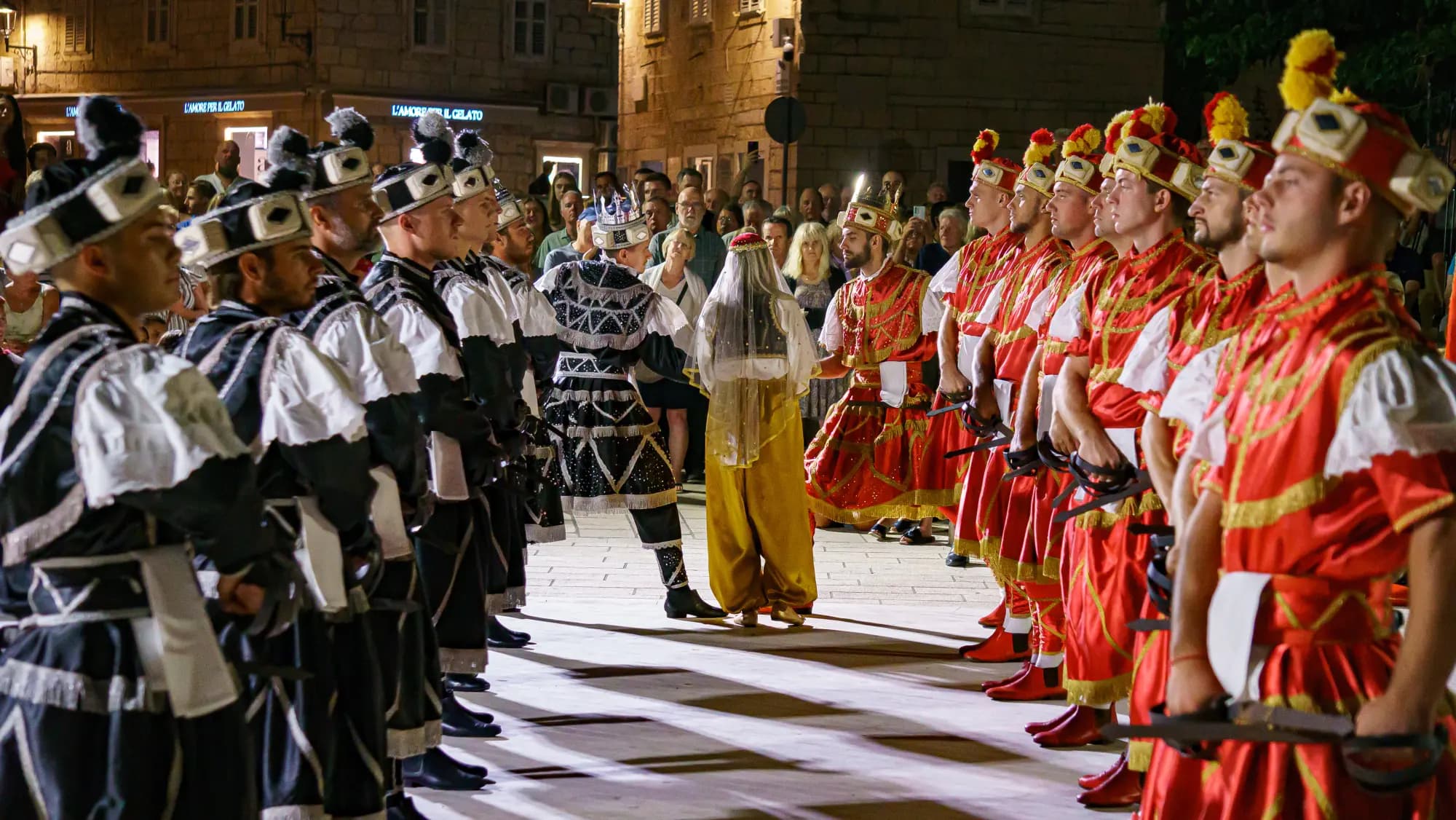
Where Swords Clash and Love Triumphs
Europe's last authentic war dance, performed since 1666.
Of all the sword dances that once spanned the Mediterranean, from Spain to Sicily, from Venice to the Greek islands, only the Moreška of Korčula has survived intact. Not as a museum piece, but as a living performance. Performed in the original 17th-century Korčulan dialect, with heavy iron swords striking hard enough to produce sparks.
The Story
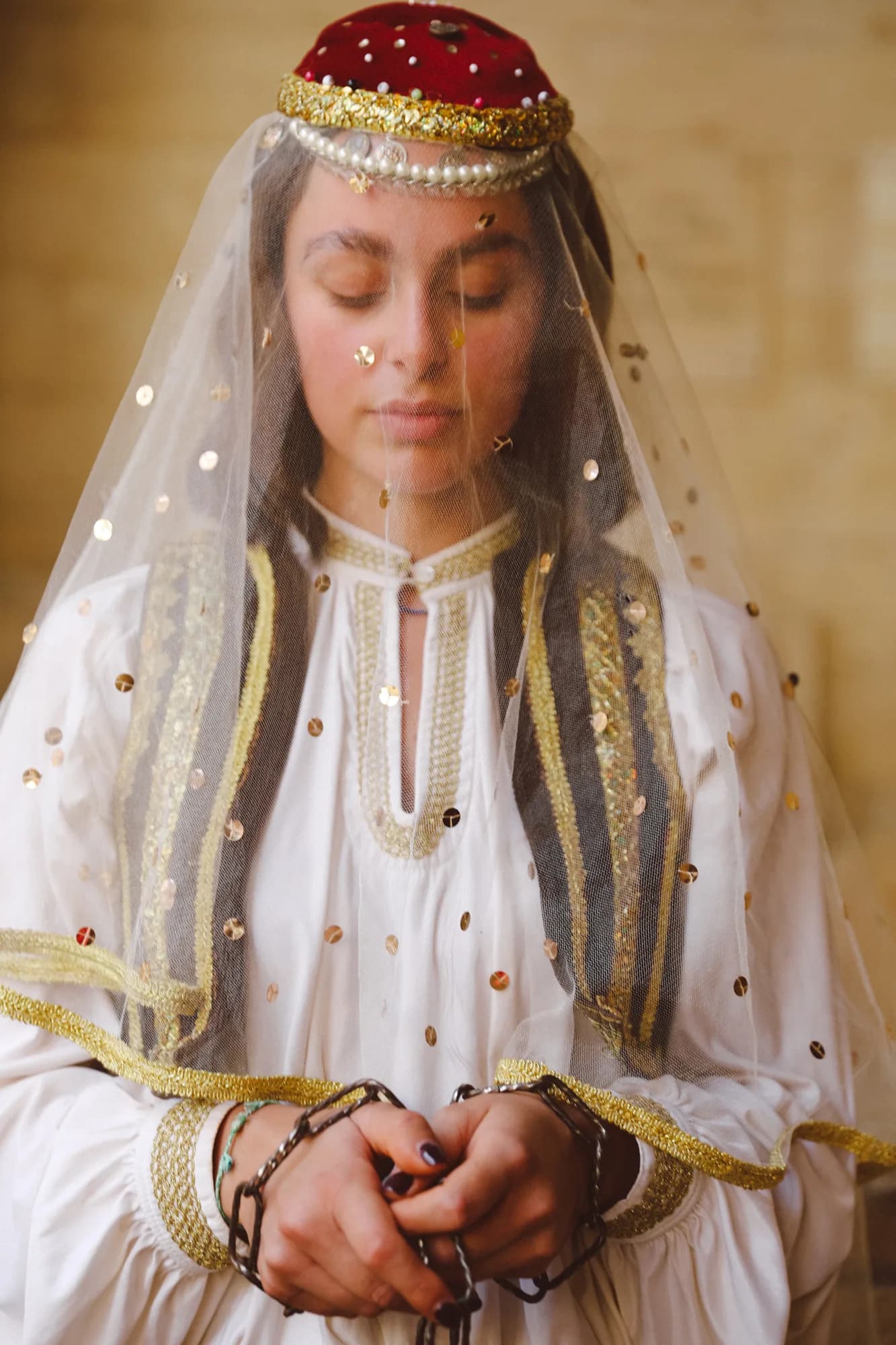
Two kings. One captive maiden. Seven battles to decide her fate. The White King, Osman, arrives to reclaim his betrothed, the Bula, from the Black King, Moro, who has taken her by force. The Bula refuses to yield: "Far more pain for me is your unwanted love than the steel." What follows is the Sfida, the challenge, and then seven kolapi: a sequence of increasingly intense sword-clash figures that escalates from lyrical circling to furious final combat. The Black army is surrounded, their circle shrinking with each figure, until the Black King surrenders his sword at Osman's feet. The Bula is freed. Virtue wins. It has always won.
The Dance
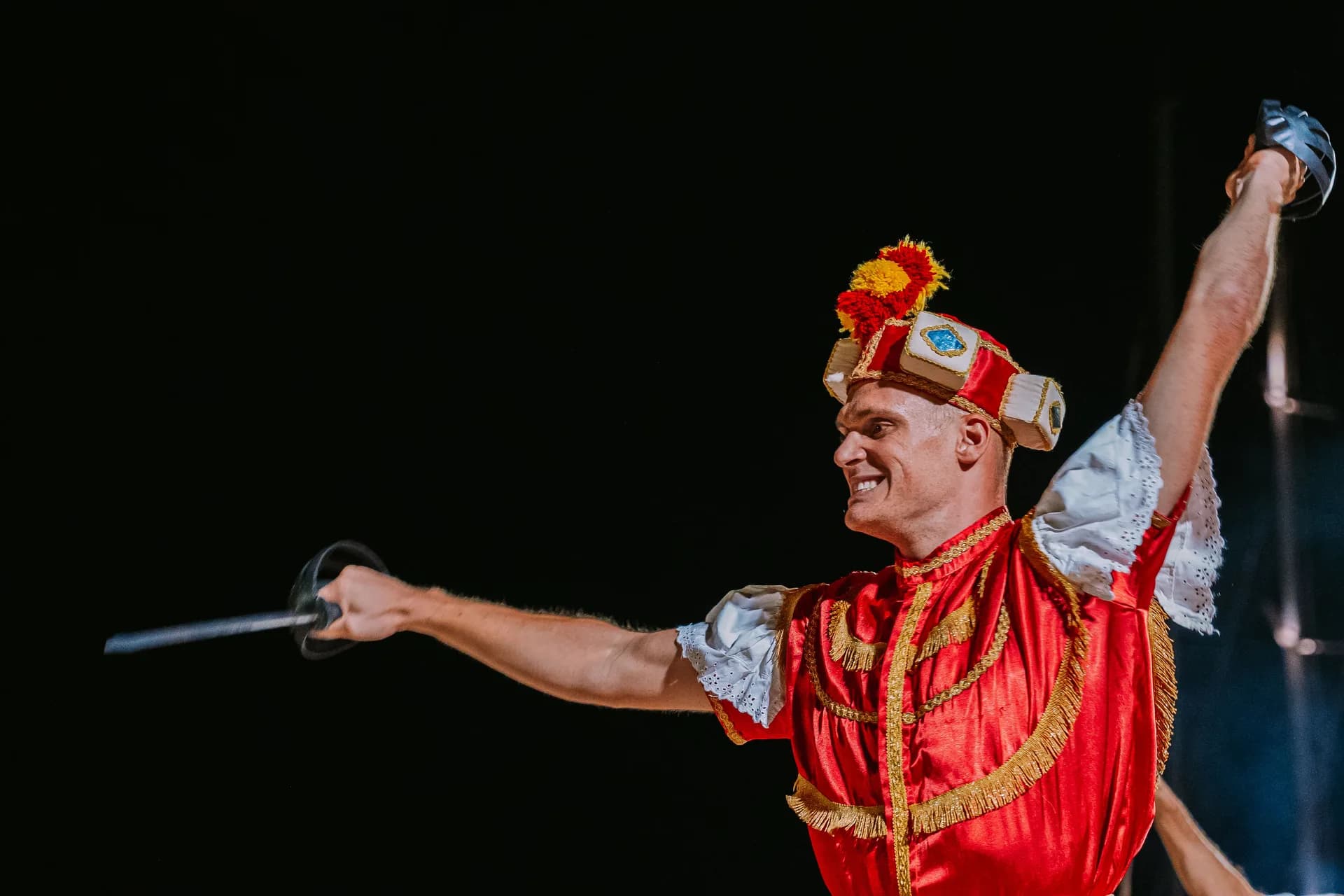
The Moreška is unique in European folk tradition for its double-sword technique: every dancer wields two iron blades: the right hand strikes, the left parries. The choreography is fixed and has been passed down unchanged for generations. Each of the seven figures has a name: Rugier, Moreška, Finta, Moro in dentro, Križ, Rugier de fuorivia, and the Final Figure, executed at full speed in 4/4 time. The sound alone is worth the journey. Iron on iron, echoing off the stone walls of the old town.
The Costume
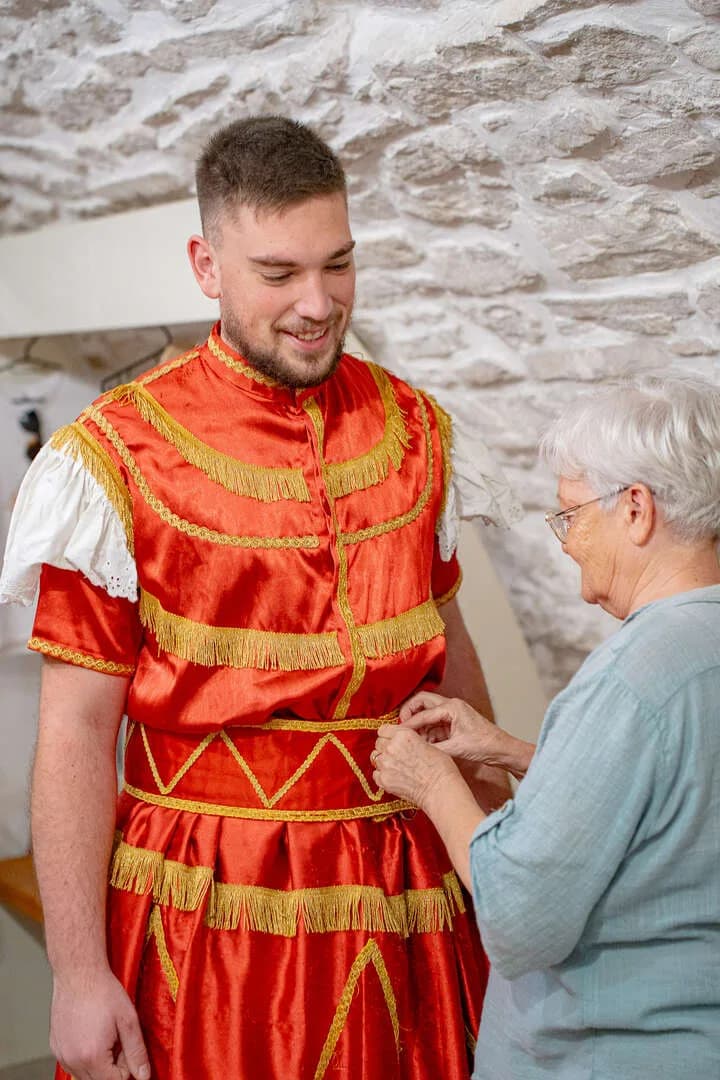
The moreškant's attire is unlike anything else in Croatian folklore: a Roman-Oriental style tracing back to 17th-century Italian court ballet. The White army wears red; the Black army wears black. Full pleated skirts, white Roman cuffs, sashes, handkerchiefs. Ornate, martial, unmistakable.
Participation
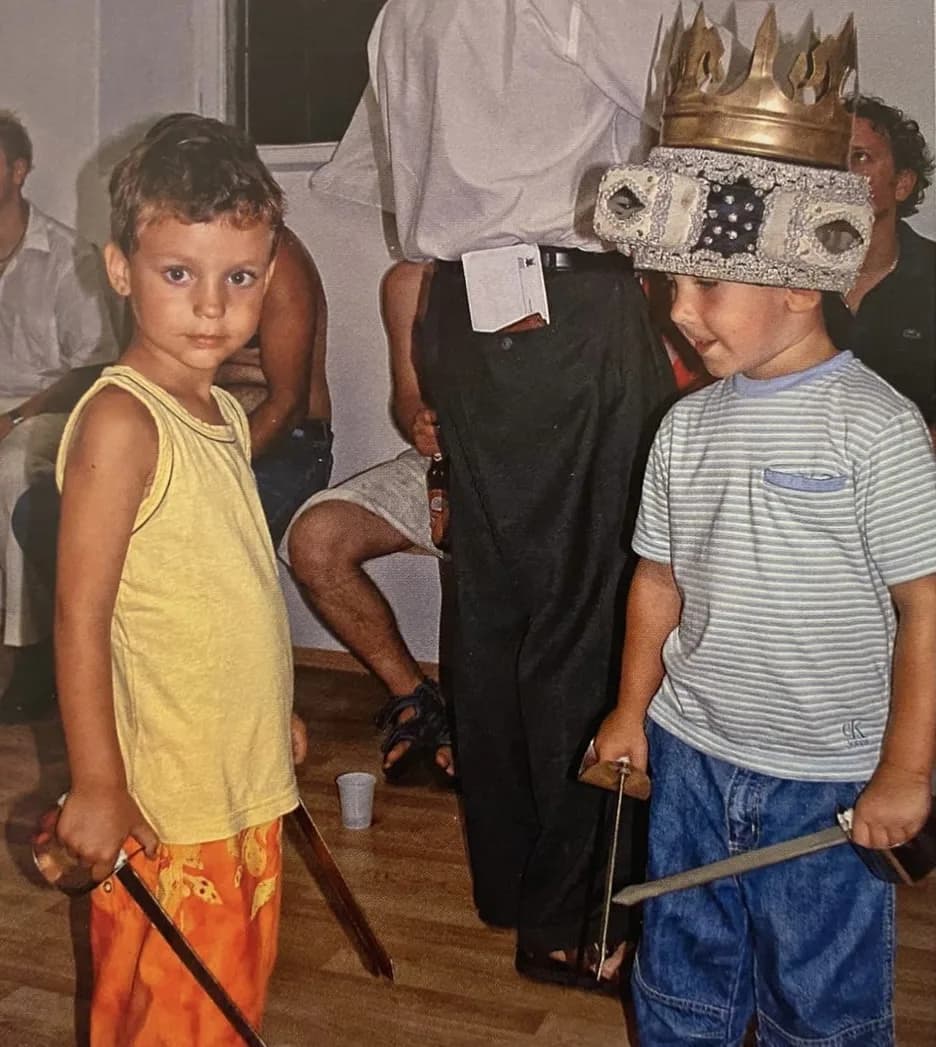
Moreška is traditionally performed by males from Korčulan families. Boys begin learning the steps in elementary school. A local saying captures what it means: "You are not a man if you cannot dance Moreška." Roles, including the kings and the Bula, are often passed from parents to children across generations.
Witness it live.
Twenty-four performances at the Summer Cinema, Korčula. May through October, 21:00.
Buy Tickets