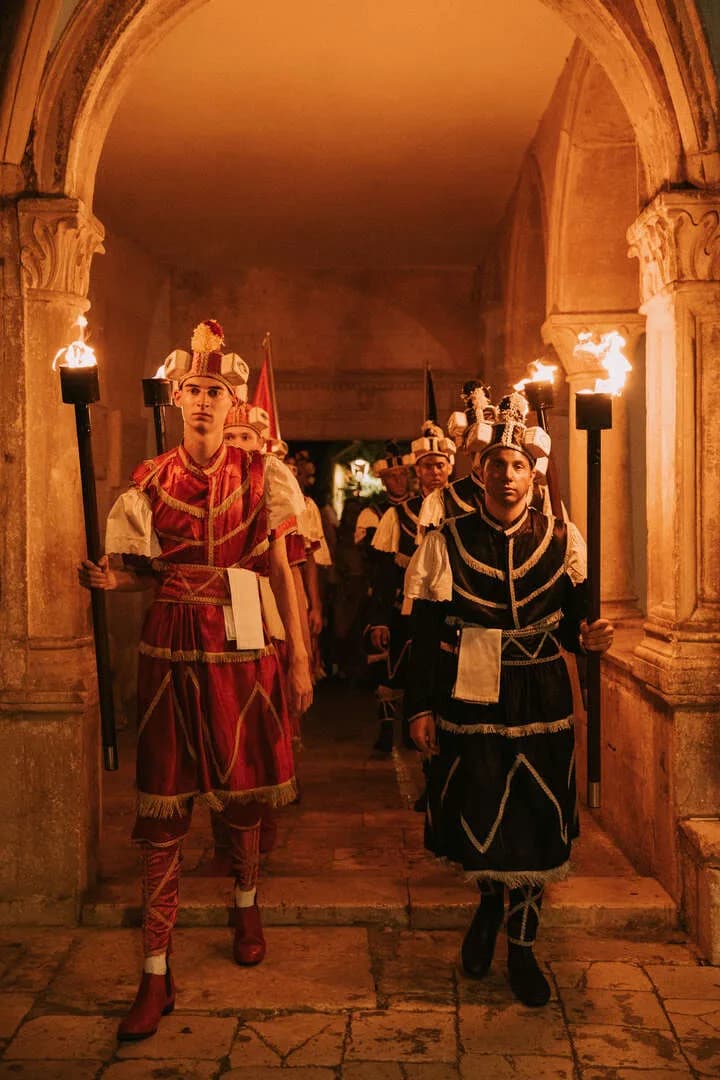
Korčula is beautiful by day, but the old town comes into its own after sunset. The crowds thin, the limestone streets glow gold under the lamps, and the sea air cools just enough to make a long evening outdoors a pleasure. If you've got a free night and you're wondering how to fill it, here's a relaxed way to spend an evening in town, built around the one thing you genuinely can't experience anywhere else.
Start with the golden hour
Korčula's old town sits on a small peninsula, so you're never far from water, and that makes it one of the best places on the Dalmatian coast to watch the sun go down. Find a spot on the western edge of the peninsula or along the waterfront promenade as the light softens. The fishbone street plan of the medieval town, laid out to catch the breeze and block the wind, is worth a slow wander while the sky changes colour.
This is also the easiest hour to appreciate the architecture: the compact, fortified core, the towers, and the narrow stone lanes that open suddenly onto the water.
Wander the old town
Once the sun is down, just walk. The old town is small enough to explore on foot in an evening, and atmospheric enough that you won't want to rush. Highlights to look out for include the central cathedral and the tight network of stone streets and stairways that have barely changed in centuries. Korčula also famously claims a connection to the explorer Marco Polo, you'll see his name around town, which makes for a fun thread to follow as you walk.
Editor's note: keep landmark and "claim to Marco Polo" references light and confirm details locally, see the README verification notes. We deliberately don't recommend specific bars or restaurants here, to keep the post evergreen and neutral; HGD can curate named suggestions if desired.
Dinner, Dalmatian style
Evening in Dalmatia is unhurried, and dinner is the centre of it. The old town and the waterfront are dotted with konobas (traditional taverns) and restaurants serving local seafood, island wine and Dalmatian classics. There's no need to plan this to the minute, part of the pleasure is choosing a table with a view of the water and letting the evening stretch.
A tip on timing: if you're planning to catch the Moreška (more on that below), it begins at 21:00, so either eat earlier or save the long, lingering dinner for afterwards.
The one unmissable evening: the Moreška
Here's the experience that turns a nice evening in Korčula into a memorable one, and the reason many visitors plan their night around a specific date.
The Moreška is a 400-year-old sword dance, performed live in the open-air Summer Cinema in the heart of the old town. It is Europe's last surviving authentic war dance: two armies, real iron swords, a dramatic story of a captured woman and the king who comes to free her, and a live brass orchestra driving seven escalating battles to a furious finale. The swords are real and strike hard enough to throw sparks, the sound rings off the stone walls of the town.
It's performed on selected evenings through the season, and it's exactly the kind of thing an evening in a medieval Adriatic town should contain: dramatic, loud, rooted in centuries of local identity, and impossible to replicate anywhere else. The performance has been staged by HGD Sveta Cecilija, the island's cultural society, since 1883.
If your evening in Korčula coincides with a performance, this is the thing to build the night around. Have an early dinner, take your sunset walk, then arrive 20–30 minutes before the 21:00 start to get a good seat (seating isn't numbered, and the earlier you arrive, the better your view).
Check which evenings the Moreška is performed and book tickets →
A simple evening plan
If you want it as a recipe:
- ~19:00, sunset walk along the waterfront and through the old town.
- ~19:30, early dinner at a konoba, or a drink with a view.
- ~20:30, stroll to the Summer Cinema and grab a good seat.
- 21:00, the Moreška: swords, music, and the most dramatic hour of your trip.
- ~22:00, a late dessert or nightcap in the lamplit streets.
Korčula's evenings reward people who slow down. Walk a little, eat well, and if the dates line up, let 400 years of clashing iron be the centrepiece. Curious what the show is actually like? Read what to expect at a Moreška performance.