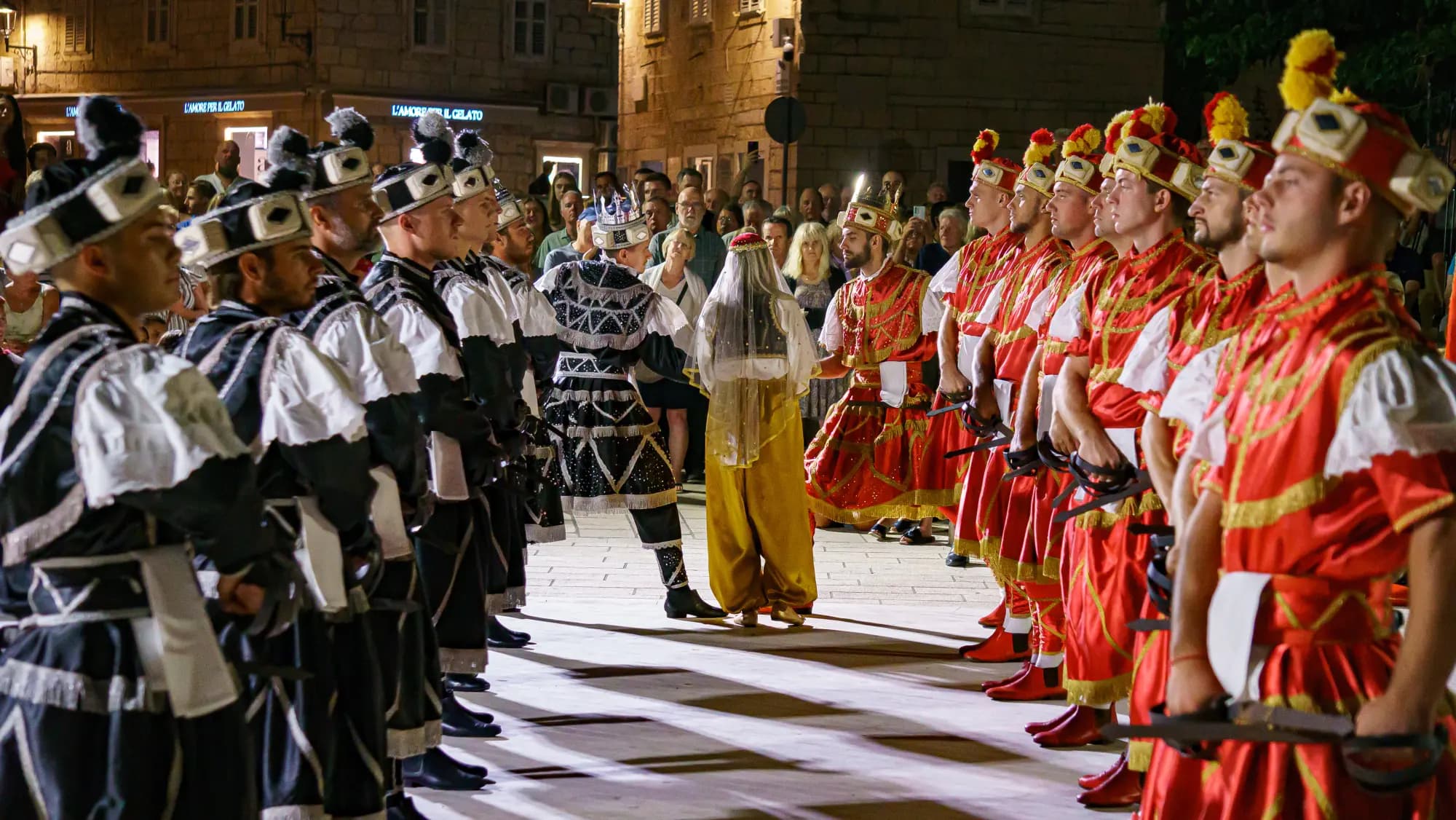
Korčula is unusual. Most places would be lucky to have one living sword dance; this single island has kept several alive. If you've been researching a visit, you've probably run into two names, the Moreška and the Kumpanjija, and wondered whether they're the same thing, or which one to see. Here's an honest explanation of how they relate, and how they differ.
One island, a treasure chest of sword dances
The island of Korčula has been described as a "unique treasure chest" of European martial heritage, because more than one sword-dance tradition survives here. In 1997 the Korčula Tourist Board launched a Sword Dance Festival specifically to bring these traditions together in one place, including the Moreška of Korčula town and the Kumpanjija and Moštra of the island's villages, such as Žrnovo, Blato and Vela Luka.
So the simplest way to understand it: the Moreška is the sword dance of Korčula town; the Kumpanjija is the sword-dance tradition of the island's villages. They are cousins, not rivals, two branches of the same island's deep relationship with the dancing blade.
What the Moreška is
The Moreška is the more theatrically elaborate of the two, and it's the one staged in Korčula town by HGD Sveta Cecilija. Its defining features are well documented:
- It's a drama as well as a dance. There's a written story, two kings, Moro (the Black King) and Osman (the White King), fight over a captured young woman, the Bula, performed in archaic 17th-century Korčulan verse before the fighting begins.
- It uses a double-sword technique. Every dancer wields two iron blades, the right hand striking and the left parrying, a feature that sets the Moreška apart from most European sword dances.
- Seven named figures. The combat unfolds in seven named kolapi, escalating in tempo to a furious finale, accompanied by a brass-band score composed by Krsto Odak in 1937.
- A Mediterranean pedigree. The Moreška belongs to the Moros y Cristianos ("Moors and Christians") tradition, traceable to a performance in Lérida, Spain, in 1150, and documented in Korčula since 1666.
It is recognised as a protected cultural good of the Republic of Croatia, and Korčula is the last place where this authentic war-dance form survived intact. You can read its full story in our history of the Moreška.
What the Kumpanjija is
The Kumpanjija is the sword-dance tradition of Korčula's villages. Our own historical sources confirm what's stated above, that it is a distinct island sword dance performed in places like Žrnovo, Blato and Vela Luka, but they don't go into detail about how it's choreographed.
A note on accuracy: Beyond "it's a village sword-dance tradition distinct from the town's Moreška," the finer points below reflect general descriptions of the Kumpanjija rather than our own verified society records. If you want the authoritative account, the local cultural societies of Blato, Žrnovo, Vela Luka, Pupnat, Smokvica and Čara are the people to ask.
In broad terms, visitors and ethnographers commonly describe the Kumpanjija as differing from the Moreška in a few ways: it tends to centre on a single linked or "chain" sword formation rather than the Moreška's twin blades and elaborate two-king drama, and it's traditionally bound up with village ceremony and identity rather than a scripted theatrical plot. The exact form varies from village to village, which is part of its charm.
Which should you see?
For most visitors to Korčula town, the answer is straightforward: the Moreška is the one performed regularly through the summer season at the open-air Summer Cinema, with live music, full costume and the seven-battle drama. It's the most accessible to plan around, and it's the dance with the documented 400-year town pedigree.
If you're travelling deeper into the island, to Blato, Žrnovo or Vela Luka, and your visit happens to coincide with a village celebration, seeking out the Kumpanjija is a wonderful, more local experience. The two aren't an either/or so much as two doors into the same remarkable island culture.
The bottom line
Korčula didn't keep a sword dance alive, it kept a whole family of them. The Moreška is the town's theatrical, twin-sword, brass-scored war dance, performed since at least 1666 and guarded by HGD Sveta Cecilija since 1883. The Kumpanjija is its village cousin. Seeing the Moreška is the easiest way to experience this heritage on a typical Korčula visit, and once you understand there's a wider tradition behind it, the whole island starts to look like the living museum it genuinely is.